

Quick Summary
Cheap leather peels because it is often not real leather at all but a thin plastic coating, usually polyurethane, bonded over a fabric or paper backing. That layer separates and lifts off in flakes, while full-grain leather, being one solid piece of hide, has no separate layer to peel.
- Budget bags, wallets and jackets often use polyurethane coating over a fabric or paper backing.
- A "genuine leather" label can mean the lowest grade of split leather or bonded material.
- Check for "full-grain" or "top-grain" before buying to avoid peeling.
- Heat, humidity and sunlight speed up breakdown of PU coatings and can cause cracking within a year.
- Test any cleaner or conditioner on a hidden area and wait 24 hours before use.
Table of Contents
- What Actually Peels: Coating, Backing and Split Leather
- How to Stop Faux Leather from Cracking and Peeling
- Repairing Peeling Faux Leather: Jacket and Bag Fixes
- Frequently Asked Questions
What Actually Peels: Coating, Backing and Split Leather
Last Updated: November 4, 2026
Cheap leather peels because the surface is often not leather at all. Most budget bags, wallets and jackets use a thin plastic coating, usually polyurethane (PU), bonded over a fabric or paper backing that lifts off in flakes when it breaks down.
Full-grain leather, unlike cheap leather, is one solid piece of hide, so there is no separate layer to delaminate. Split leather is weaker but still real leather. Bonded leather, shredded fibers pressed together with glue and coated, often peels like faux leather.
Watch out: a "genuine leather" label on a cheap item often means the lowest grade of split leather or bonded material. Check for "full-grain" or "top-grain" before you buy.
Identify the material before you repair or condition it
Identifying what you own is the most useful step, because coated split leather, bonded leather, PU faux leather, and full-grain or top-grain leather fail differently and need different care. Our guide to spotting fake leather before you buy walks through the checks.
Why the failure modes differ
Surface-finish failure and coating delamination are not the same problem. On full-grain and top-grain leather, what looks like peeling is usually the finish or dye wearing thin, the hide underneath is intact. On coated split, bonded, and PU materials, the plastic layer physically separates from its backing and keeps spreading unless the loose edge is stabilized.
A worn finish on real leather can often be recolored or conditioned. A delaminating coating on bonded or faux leather cannot be re-bonded permanently at home, the best you can do is slow the spread and hide the damage. If unsure, treat the item as coated until proven otherwise, and test any product on a hidden area first.
The article breaks down what each type of cheap leather is made of and how each one tends to fail.
| Material | What it is | How it fails |
|---|---|---|
| Full-grain leather | One solid piece of hide | Finish or dye wears thin; no separate layer to delaminate |
| Split leather | Weaker real leather | Coating can separate from the split layer |
| Bonded leather | Shredded fibers pressed with glue and coated | Often peels like faux leather |
| PU faux leather | Plastic coating over fabric or paper backing | Coating lifts off in flakes |
How to Stop Faux Leather from Cracking and Peeling
Heat, humidity and sunlight speed up the breakdown of PU coatings. A car seat, a radiator-side shelf or a sunny windowsill can cause cracking within a year. Keep faux leather out of direct sun and away from heaters.
Flexing also wears coatings down. High-friction spots such as the handle, the strap join and the bottom corners crack first. Rotate bags and avoid overstuffing them. If you are buying a new wallet, see how to choose durable leather wallets for men that hold up to daily use.
Clean with a damp cloth and mild soap, then dry it right away. Avoid oils and harsh solvents, which can soften the coating.
Prevention by material and product
Generic "condition your leather" advice can do more harm than good on coated and synthetic materials, so match the care to what you own.
Storage and lifespan
Storage conditions decide how long a coated item lasts before visible peeling begins. Humidity above roughly 60 percent encourages hydrolysis of PU coatings, while very dry air makes them brittle; aim for a stable, moderate environment. Never store faux or bonded leather in a sealed plastic bag, use breathable cotton dust bags instead, and keep items out of attics and garages where temperatures swing.
Test products before you commit
Cleaners and conditioners intended for natural leather can damage faux and bonded leather, sometimes within a single application. Test any product on an inconspicuous area such as the inside of a hem, the underside of a cushion, or a hidden seam allowance. Apply a small amount, wait 24 hours, and check for softening, tackiness, color shift, or lifting at the edge. If any appear, do not use it on the visible surface.
Watch out: a product marketed simply as "leather cleaner" is not automatically safe for PU or bonded leather, check that the label specifies coated, synthetic, or faux leather before applying it.
Repairing Peeling Faux Leather: Jacket and Bag Fixes
Small peeling areas can often be repaired at home. Clean the area and remove loose flakes with tape or a soft brush, then follow these steps:
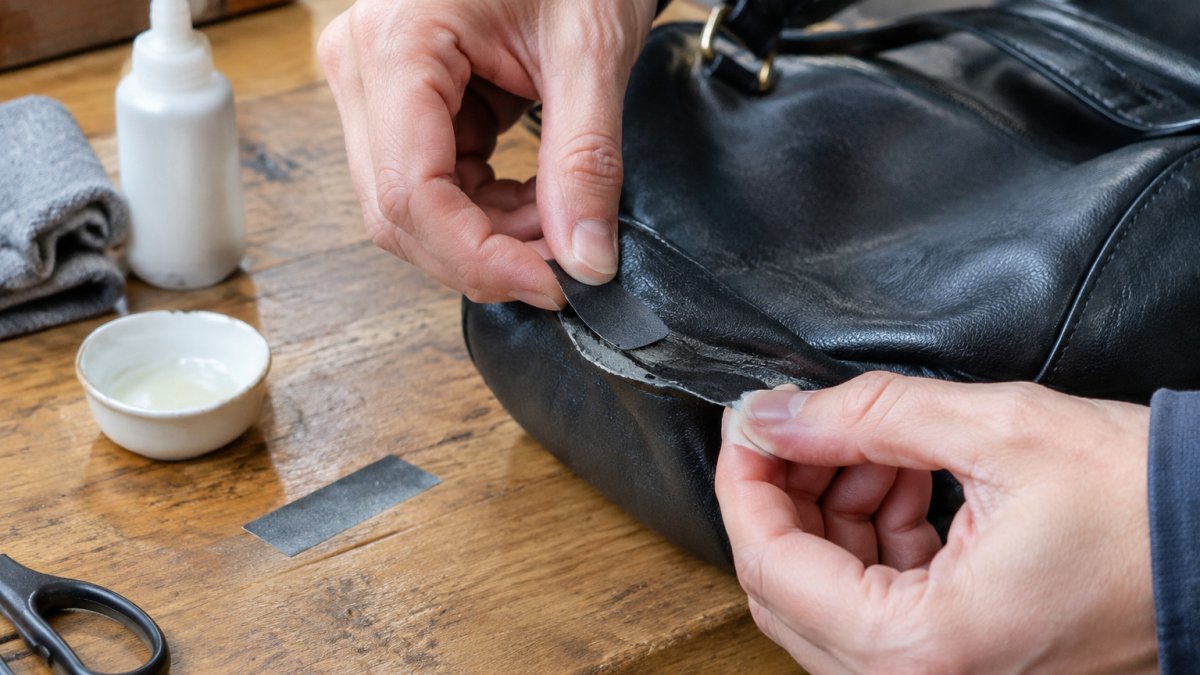
For large areas, heavy flaking or split seams, a professional repair or replacement is usually the better choice. Forge-Hollow uses full-grain hides with no laminates or plastic coatings, so the leather develops a patina rather than peeling. Our briefcase range shows what solid leather construction looks like in practice.
Frequently Asked Questions
Does real leather peel or crack?
Real leather can crack, especially full-grain hides that are dried out or left in heat, but it does not peel the way coated materials do. Peeling happens when a plastic or polyurethane layer separates from its backing. Genuine leather with a thin finish may flake at worn edges, yet the grain itself stays attached. If a surface lifts off in sheets, the item is probably faux or bonded leather. Conditioning and keeping it away from direct sunlight and radiators slow down cracking considerably.
Can peeling faux leather be repaired?
Small peeling areas can often be repaired with a flexible leather or vinyl adhesive, applied thinly and pressed under a flat weight while it cures. Clean the loose edge with isopropyl alcohol first so the adhesive grips. Large areas where the coating has fully separated are harder to fix, and a patch or professional recolouring may be the realistic option. Repair works best early, before the surrounding coating dries out further.
How can you tell real leather from faux or bonded leather?
Look at the edges and the back. Genuine leather shows a fibrous, uneven cross-section and a soft, slightly irregular grain that varies across the surface. Faux leather has a uniform, repeated pattern and a plastic-like sheen. Bonded leather shows shredded fibres glued together, often visible at the cut edge. Press a fingernail into an inconspicuous spot: leather creases naturally, while coated materials often show a flat, stretched look.
