

Last Updated: November 4, 2026
Quick Summary
A handcrafted leather briefcase is built by skilled makers who cut, stitch and finish each bag by hand, which gives better control over the stress points that fail first on a working bag. Full-grain hide, burnished edges and waxed-thread stitching help it last years of daily use, so its cost per use can fall below that of cheaper bags.
- Hand-stitched corners let a maker backstitch and lock stress points, where most stress on a briefcase concentrates.
- Burnished edges feel hard and smooth, while painted edges can crack and peel within about a year.
- Full-grain hide keeps its natural fibre strength because its surface is not sanded away or coated.
- Overloading is the most common cause of handle and seam failure, and most warranties do not cover it.
- Divide the purchase price by working days of use to compare cost per use against cheaper alternatives.
Table of Contents
- What Makes a Leather Briefcase Handcrafted
- Benefits of Full-Grain Leather for Work Bags
- Durability Under Daily Office Stress
- Patina, Wear, and the Professional Image
- How to Care for a Leather Briefcase
- Cost-Per-Use: Is a Handcrafted Briefcase Worth the Price
- Weight, Comfort, and Organization for Daily Carry
- Ethical Sourcing and How to Verify It
- Choosing Your Next Work Briefcase at Forge-Hollow
- Frequently Asked Questions
What Makes a Leather Briefcase Handcrafted
A handcrafted leather briefcase is one where skilled makers shape, cut, stitch and finish the bag by hand, rather than relying on a production line to do most of the work. Forge-Hollow builds its briefcases this way, and the differences show up in the seams, the edges and the way the leather ages over the years.
Handcrafting is not a single technique. It is a sequence of decisions made at each stage, from selecting the hide to finishing the last edge. Understanding those stages helps you judge whether a briefcase is worth its price.
Hand Stitched vs Machine Stitched Leather
The stitching is often the first place where handcrafting becomes visible. Hand-stitched seams are typically worked with waxed thread pulled through pre-punched holes, one stitch at a time. Machine stitching is faster and more uniform.
Forge-Hollow uses waxed thread for its stitching. Neither method is automatically a sign of poor quality, but hand stitching gives a maker more control over tension at the corners, where most stress on a briefcase concentrates. When you inspect a bag, look at those corners first.
Hand-Cutting and Edge Burnishing
Hand-cutting lets a maker follow the natural shape of each hide.
Edge burnishing is the step that gives a finished leather edge its smooth, sealed look. The edge is sanded, dampened and rubbed until the fibres compress and bond.
Benefits of Full-Grain Leather for Work Bags
Full-grain leather is the outermost layer of the hide with its original surface intact. Because the grain is not sanded away or coated, the material keeps its natural fibre strength.
Forge-Hollow uses only full-grain hide, with no laminates or plastic coatings. For pairing with a briefcase, you can also see how durable leather wallets are chosen.
Durability Under Daily Office Stress
A work briefcase faces constant handling: being set down on floors, squeezed into car footwells, stuffed past its comfortable capacity and carried through rain. Durability in this context means the bag keeps its shape, its handles stay attached and its seams stay closed under that repeated stress. The more useful question is where a briefcase actually fails, and what to inspect before you buy.
The Four Failure Points on a Working Briefcase
Most premature briefcase failures cluster around four areas, and each one tells you something different about construction quality.
1. Handle attachments. The handle-to-body junction takes the full weight of the bag every time you lift it. On cheaper bags, handles are often riveted or glued into a thin panel; under a loaded laptop and documents, the rivets loosen and the leather around them stretches into an oval. Look for handles that are stitched through a reinforced panel or anchored with a leather patch that distributes load across a wider area.
2. Seam corners. Corners concentrate stress because the leather is folded and the thread is pulled in two directions at once. Machine stitching can skip or bunch at thick corners; hand stitching lets the maker backstitch and lock the corner. When inspecting a bag, turn it inside out at the corners and look for loose thread, skipped stitches or gaps where the panels meet.
3. Edge finish. Burnished edges seal the leather fibres so they do not fray or absorb moisture. An edge that is painted rather than burnished will crack and peel at the corners within a year of daily use. Run a thumbnail along the edge: a well-burnished edge feels hard and smooth, while a painted edge feels like a thin coating over soft leather.
4. Hardware. Zippers, buckles, D-rings and feet are where most articles say nothing, yet they are the most common point of failure after the handle. A bag with excellent leather and a cheap zipper will still fail at the zipper. Look for metal hardware with a solid feel and smooth action, stitching that passes through the hardware tab rather than around it, and zipper tape that is stitched, not glued, into the bag.
How Leather Type and Thickness Affect Lifespan
Full-grain hide keeps its natural fibre strength because the surface is not sanded away. That matters for durability, but thickness matters too. A 1.2 mm full-grain panel and a 2.0 mm full-grain panel are both 'full-grain,' yet the thicker panel resists sagging and corner wear far better under a daily laptop load. Most practitioners find that the base and handle panels benefit most from thicker hide, while side panels can be slightly thinner to keep weight down.
Forge-Hollow uses full-grain hide with hand-cut panels, burnished edges and waxed-thread stitching, and designs its briefcases to withstand daily stress. But no bag survives indefinitely without care. Stretched handles, sagging bases and dry leather are usually the result of overloading or neglect rather than defective materials, so matching the bag to your load matters as much as the bag itself.
Watch out: a briefcase rated for a 16-inch laptop is not automatically rated for a 16-inch laptop plus a power brick, a water bottle and a stack of files. Overloading is the single most common cause of handle and seam failure, and it is not covered by most warranties.
The four points below are where a working briefcase most often fails, and what to check for on each.
| Failure point | What to check | Why it matters |
|---|---|---|
| Handle attachments | Stitched through a reinforced panel or anchored with a leather patch | Takes the full weight of the bag on every lift |
| Seam corners | Look for backstitched, locked corners with no skipped stitches | Corners concentrate stress from two directions at once |
| Edge finish | A burnished edge feels hard and smooth, not like a coating | Painted edges crack and peel within about a year |
| Hardware | Solid metal, smooth action, stitched zipper tape | Zippers and buckles are a common point of failure after the handle |
Patina, Wear, and the Professional Image
Patina is the darkening, softening and surface sheen that full-grain leather develops through use, exposure to light and handling. Many owners see this as a feature. Others worry that visible wear will make a briefcase look neglected in a client meeting.
The honest answer depends on the setting and the owner. A well-cared-for leather briefcase typically looks refined rather than worn, because the wear is even and the leather stays supple. Scuffs and deep creasing are the signs that a bag has been mistreated, and those can be reduced with regular conditioning. If a pristine appearance is essential to your role, you can choose a lighter-tone leather and keep it conditioned to slow the darkening.
How to Care for a Leather Briefcase
Leather care is simple but consistent. Most owners do best with a short routine rather than occasional deep treatments.
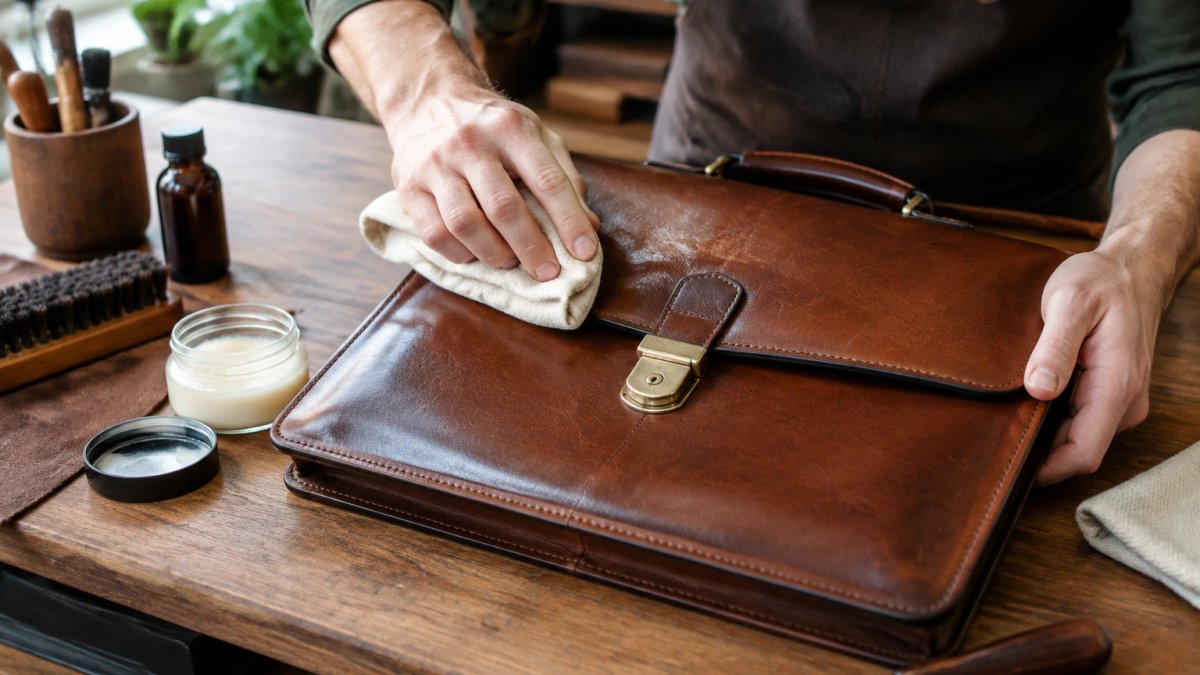
- Wipe after use. Use a dry or barely damp soft cloth to remove dust and grime, especially after exposure to rain.
- Condition every few months. Apply a small amount of a leather conditioner with a soft cloth, then let it absorb and buff off the excess.
- Keep it away from heat. Direct sun and radiators dry out leather and can crack the surface.
- Stuff it lightly when empty. Gentle padding helps the briefcase hold its shape in storage.
- Address spills quickly. Blot liquids immediately rather than rubbing them in.
Avoid harsh household cleaners, silicone-based sprays and heavy oils, which can darken or damage the finish. When in doubt, test any product on a hidden area first.
Cost-Per-Use: Is a Handcrafted Briefcase Worth the Price
Cost-per-use is a practical way to judge a briefcase. Divide the purchase price by the number of working days you expect to use it, and compare that figure against cheaper alternatives. A bag used daily for many years can have a lower cost per use than a less expensive bag replaced every couple of years. That is the standard argument, and it is true, but it is also incomplete. The more useful version accounts for repair, resale and the hidden cost of replacement.
A Worked Comparison
Consider two buyers who each commute to an office five days a week, roughly 250 working days a year.
Buyer A chooses a mass-produced bag at a lower upfront price and replaces it every two years when the zipper fails or the handle attachment tears. Over ten years, that is five bags. The cost per working day is the total spent divided by 2,500 days.
Buyer B chooses a handcrafted full-grain briefcase and keeps it for ten years, with one handle repair and routine conditioning. The cost per working day is the purchase price plus the repair, divided by 2,500 days.
You do not need exact prices to see the pattern: the handcrafted bag wins on cost per use whenever it lasts roughly twice as long as the cheaper alternative, which is a common outcome when the leather is full-grain and the hardware is serviceable. The crossover point is usually earlier than buyers expect.
The Three Costs Most Buyers Forget
Repair cost. A briefcase with stitched construction and standard hardware can be repaired by a leatherworker. A bag with glued panels or proprietary hardware often cannot. Ask before you buy whether the maker offers repairs and whether the hardware is standard enough for a third-party leatherworker to replace.
Resale value. Full-grain leather briefcases from known makers hold resale value in a way that synthetic or bonded-leather bags do not. A well-maintained bag can be sold or passed on, which lowers the effective cost per use further.
Replacement friction. The cost of a cheap bag is not only the price. It is the time spent researching a replacement, the disruption of switching bags, and the risk of a failure on a day you needed the bag most. Those costs are real even though they do not appear on a receipt.
When a Handcrafted Briefcase Is Not Worth It
The cost-per-use case depends on frequency of use. If you carry a briefcase once a month, a handcrafted full-grain bag may never amortize its price against a cheaper option. The math favors handcrafted construction when the bag is used daily, when it carries a heavy load, and when you intend to keep it for years rather than replace it on a trend cycle.
Pricing for Forge-Hollow briefcases depends on the model and any current offers, so please check the website for current prices. Remember that the real comparison is not the sticker price alone but how long the bag stays functional and presentable, and whether it can be repaired or re-conditioned rather than discarded.
Weight, Comfort, and Organization for Daily Carry
Weight matters for daily commuting. A briefcase that is heavy before you add a laptop and documents adds strain to the shoulder and back over time. Leather bags are generally heavier than synthetic equivalents, so it is worth checking the empty weight of any model you are considering against your typical load.
Organization is equally important. Look for a padded laptop compartment that fits your device snugly, separate pockets for documents and accessories, and a strap or handle that distributes weight comfortably. Forge-Hollow's briefcases include a padded 16-inch laptop compartment, but measure your device before you buy.
Ethical Sourcing and How to Verify It
Many brands describe their leather as ethically sourced, but the claim is only useful if it can be checked. Ask where the hides come from, which tannery processed them and what tanning method was used. Vegetable tanning and chrome tanning have different environmental profiles, and a credible supplier should be able to explain its choice.
Forge-Hollow sources its hides from ethical tanneries. If you want to verify this for yourself, request information on the tannery partners and tanning processes directly from the company before purchasing. Independent certifications and third-party audits are the strongest form of evidence, so ask whether any apply.
Choosing Your Next Work Briefcase at Forge-Hollow
Choosing a handcrafted briefcase comes down to matching the bag to your daily reality: how much you carry, how often you travel, how formal your environment is and how you feel about the leather aging over time. Forge-Hollow crafts its briefcases from full-grain hide with hand-cut panels, burnished edges and waxed-thread stitching, designed to outlast synthetic alternatives.
If you are ready to compare models, visit the Forge-Hollow website to see current options, dimensions and prices.
Frequently Asked Questions
Are leather briefcases still in style?
Yes. Leather briefcases remain a standard in professional settings because they signal formality and suit business attire well. Styles have shifted toward slimmer profiles, cleaner hardware, and neutral tones such as tan, dark brown, and black. A well-made leather briefcase in a classic silhouette will look current for years, which is the main reason many professionals treat it as a long-term purchase rather than a seasonal accessory.
Is handcrafted leather genuine leather?
Handcrafted leather is genuine leather when the maker uses real hide. The term describes how the piece is made, not what material it is. Forge-Hollow uses full-grain hide with no laminates or plastic coatings. Because methods vary between makers, check whether a brand names the leather grade and tannery. Real leather shows natural grain variation and may have small marks, which are normal features of the hide.
What is the difference between handcrafted and mass-produced leather briefcases?
Handcrafted briefcases are typically hand-cut, hand-finished, and stitched by hand, rather than relying mainly on automated cutting and machine stitching. Mass-produced versions often use split leather, bonded leather, or coated materials to reduce cost.
How does full-grain leather hold up to daily office wear and tear?
Full-grain leather keeps the hide's original outer layer, which is the strongest part of the skin. That density lets it resist tearing and abrasion from daily carry, including bumps against desks, car seats, and transit. Scuffs and fine creases are expected and tend to blend into the surface over time. Regular conditioning and avoiding prolonged exposure to rain or direct heat will extend the life of the leather considerably.
How do I care for a leather briefcase at work?
Wipe the surface with a dry cloth after each day of use, and address spills immediately with a barely damp cloth. Condition the leather every few months with a product suited to full-grain hide, applying a thin layer and buffing it off. Store the briefcase upright or with its shape supported when not in use, and keep it away from radiators and damp areas. Avoid silicone-based products, which can darken or seal the leather.
Is a handcrafted leather briefcase worth the higher price point?
Whether it is worth the price depends on how often you use it and how long you plan to keep it. Spread across years of daily use, the cost per use can be lower than replacing a cheaper bag every few years. Pricing depends on the build, materials and any customization, so check Forge-Hollow's website for current prices or request a quote before deciding.
What should I look for in a high-quality leather briefcase?
Look for full-grain hide named on the product page, edges that are burnished and smooth rather than painted or glued, and stitching that is even and tight with waxed thread where possible. Check the hardware for solid buckles and zippers that operate smoothly. Confirm the interior layout fits a laptop and daily documents, and ask about warranty coverage for seams and materials before you buy.
